
The Complete Guide to Selling Your Home in El Paso
Want to see exactly what our team does for your listing? What Happens When We List walks through the launch, marketing, showing feedback and who handles each step.
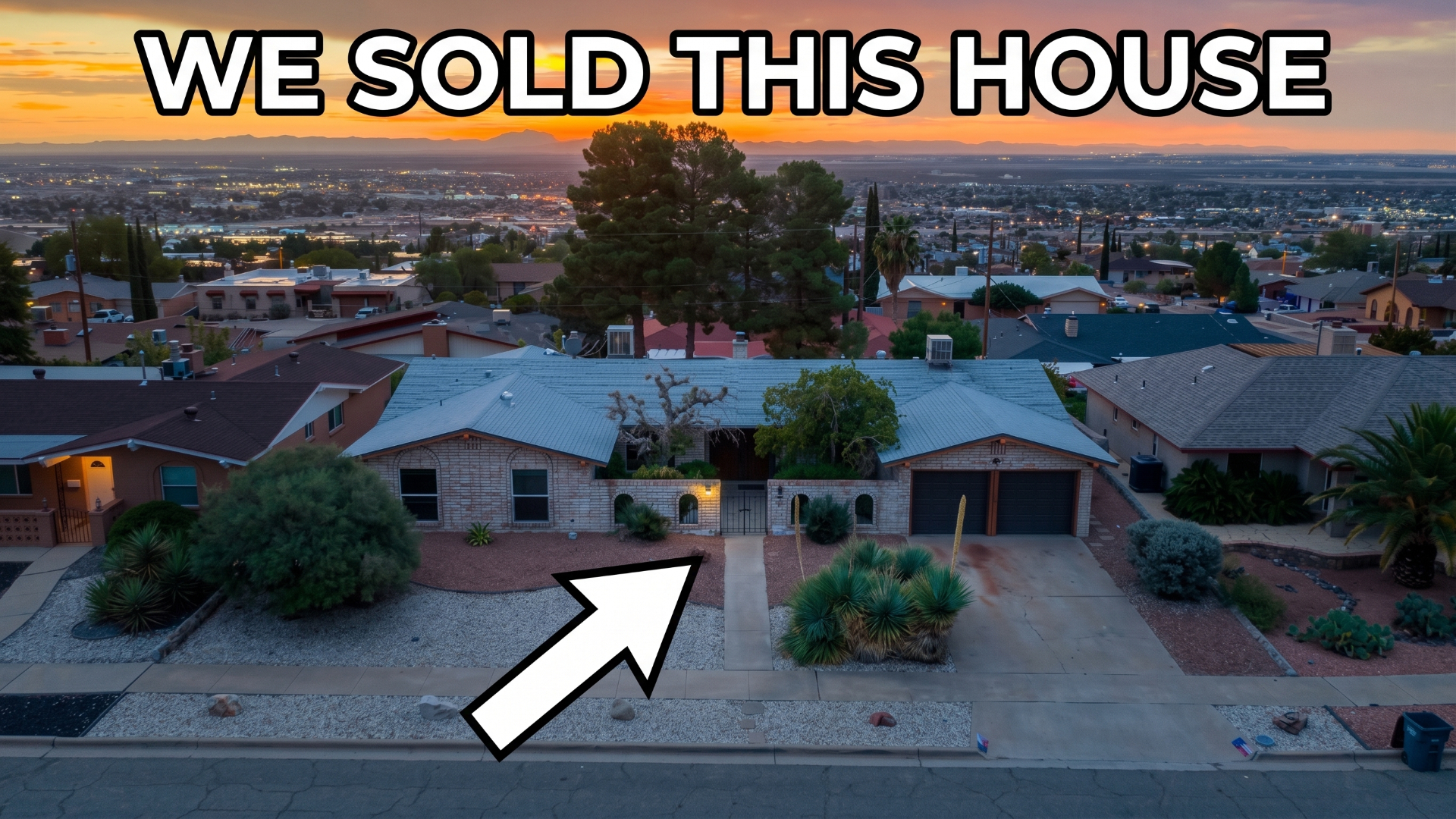
What does selling a home in El Paso actually look like, start to finish?
Ten steps. Most people only picture two of them, which is why the middle of this process feels chaotic when nobody walks you through it in advance. If you are selling in order to buy again, the timing is different; here is our guide to selling your home and buying the next one at the same time.
1. The listing appointment
We come out and walk the home with you. Then we go through the four things that set your price, which are broken out further down this page, and we give you a number along with the reasoning behind it.
You should never get a price from an agent without getting the logic with it. A number by itself is an opinion. A number with comparable sales, absorption rate and an honest read on your home's condition is a recommendation. That is also why the online estimate on your home is usually wrong.
If we decide the timeline for you selling your home, we discuss the worst-case scenario versus best-case scenario as far as price and timeline. Right then and there, we propose the option of professionally staging the home, along with the cost of it. We let you know how much money you're going to walk away with after you sell and set the expectations for standard and consistent communication throughout the transaction.
2. Prep to List
We tell you exactly what to repair, what to clean, and what furniture to move or remove if you are not staging.
This is where sellers make or lose real money, and it is the part most agents skip because it is an uncomfortable conversation. We would rather have it with you than let you find out from a buyer who walked out after ninety seconds.
After a few hundred listing appointments, the same three things come up every time.
- Minimize the furniture and what is on the walls. Ideally, every room has only two pieces of furniture and one item on the wall.
- Pets. A professional cleaning is highly recommended if you have pets — either temporarily move them out of the house or find a way to make it not seem as if pets live there.
- Obvious repairs. Anything visible to the naked eye, such as water stains on the ceiling, should be patched up before the home goes up for sale.
3. Photos and video
Professional photos and drone footage. From the minute your home is ready for pictures, we can have it on the market within seven days.
4. On the market
Your listing goes live, and your home tour video goes on the most followed real estate page in El Paso along with the Instagram page of every agent on our team. That is exposure you are not getting from a sign in the yard and a lockbox.
A Bluetooth lockbox is installed in your home, which is what realtors use to gain access to show your property to their clients. Only realtors can access this lockbox, and it shows your listing agent (which is us) as the last person to access it.
As far as coordinating showings, we typically request — especially when you're living in the home — a 24-hour notice. Sometimes they do come in last minute, and when they come in, you automatically get notified, and then we wait for you to confirm or deny the appointment.
5. Showings
Every single time somebody shows your home, you hear from us. Not a weekly summary. Every showing. Here is how to get ready for them: preparing for showings.
And every Monday you get an update directly from your listing agent, whether there is news or not.
Although we give home buyers and their realtors specific instructions on what they can and can't do when showing your home, we must say we cannot fully control the actions of others. Sometimes people will leave lights on. This is going to be controversial. We counter this by visiting your property every 2 weeks to check on it if it is vacant. Also, at a homeowner's request, we require home buyers to take their shoes off or wear shoe booties while viewing the home.
6. Offers
When offers come in, our job is to create a frenzy, because the goal is not one offer at a good price, it is as many offers as possible at the highest price the market will give.
Then we lay them out for you in a simple spreadsheet that puts the important details side by side. Contracts are dense and they are designed to be compared by people who read them all day. You should not have to become one of those people to choose between two offers. Here ishow to read an offer beyond the price. Got an FHA or VA offer? Read should you accept an FHA or VA offer.
The ten decisions in every offer you receive
- 1
The price the buyer is offering you
Where they open, priced off comparable sales
- 2
The earnest money deposit
Their good-faith deposit, at risk if they walk without cause
- 3
The option money
A small fee that buys them an unrestricted inspection window
- 4
The option period
How many days they can walk away for any reason
- 5
Who's paying for the title policy?
The policy proving you can actually sell the home. Customarily you, in Texas
- 6
Who's paying for the survey?
Who covers confirming where the property lines are
- 7
Requesting seller help with closing costs
A credit from you toward the buyer's closing fees
- 8
Requesting seller help with buyer agent compensation
Asking you to cover the buyer's agent's compensation
- 9
Requesting personal property or real property
What stays with the house: fridge, blinds, playset
- 10
Third-party financing days
How many days the buyer's lender gets to give final approval
7. Under contract
Once you accept an offer, the clock starts. Inspection, repair negotiations, the appraisal, and everything it takes to get the file clear to close. We handle the negotiating. You get told what is happening. Here is how those three pieces work from the seller's side. And if the buyer walks away before closing, here is what happens if your buyer backs out.
8. Inspection
The buyer hires a licensed inspector who walks through your home and documents the condition of the roof, foundation, HVAC, electrical, plumbing, and everything else Texas requires them to look at. Almost every report comes back with findings, even on well-kept homes. A long report does not mean a bad house. It means an honest set of eyes.
Then comes the part sellers are rarely warned about: buyers will oftentimes try to negotiate thousands of dollars in repairs off that report. Typically, repairs stay under $5,000, and about 99% of the time they go over $1,000. That is definitely something to budget for, and it is not a lot of people talk about, because it is not included in the net amount when discussing how much money goes in your pocket when selling your home.
We handle those negotiations for you. We push back on the asks that are not worth paying for, and we tell you honestly which ones are, before they put your sale at risk.
9. Appraisal
This one is important, because the home typically will only sell for what it appraises for, unless your home is just one of the top 1% unique homes and a buyer is willing to overpay for it. If the home appraises for less than what the buyer is buying it for, there is a good chance you might get backed up into a corner and have to sell it at that.
Here is our guide on navigating appraisal situations in our resources tab: navigating appraisal situations in El Paso. And for the full seller playbook, here is what you can do as the seller when the appraisal comes in low.
10. Closing
You sign, the title company funds, and you get paid. You do not have to be present in the city for closing. You can close out of state with a mobile notary for about $250, or with power of attorney if you are out of the states.
After closing, call your homeowners insurance and your mortgage company to ask when you should expect your refund for escrows.
Wondering exactly when the money lands? Here is when you get your money after selling.
What does it cost to sell a home in El Paso?
More line items than people expect, and the ones that surprise sellers are not the obvious ones.
Here is every cost, what it is, and roughly what it runs in El Paso.
| Cost | What it is | Typical in El Paso |
|---|---|---|
| Title policy | Insurance guaranteeing the buyer clear ownership. Customarily paid by the seller in Texas | about $1,500 |
| Escrow fee | What the title company charges to handle the closing | about $500 |
| Survey | A drawing of your property boundaries. Sometimes your existing one works | about $600 |
| Attorney document preparation | Preparing the deed and closing documents | about $250 |
| State of Texas fee | A small state charge collected at closing | $2 |
| Property taxes | Your share, from January 1 through the day you close | Depends on your rate and closing date |
| Homeowners insurance | You carry it from January 1 through the day you close | Depends on your policy |
| Repairs | Before listing, and again after the buyer's inspection | usually $2,000 to $5,000 |
| Cleaning | Before photos and again before closing | about $500 |
| Staging | Optional upgraded package, see below | 1.5% |
| Real estate commissions | Negotiable, see below | Negotiable |
| Buyer's agent compensation | If you agree to cover it in the negotiation | Negotiable |
| Buyer's closing costs | If you agree to cover some or all of them | Negotiable |
| Holding costs | Every month the home sits: your mortgage payment plus utilities | Your monthly payment plus utilities |
On a $300,000 home, the fixed pieces at the title company come to roughly $2,850 before you get to repairs, cleaning, taxes, or anything you negotiate. Every line is worked through in how much you will walk away with.
The one nobody budgets for is the last one. Every month your home does not sell, you are still making that payment. Two extra months on the market on a $1,800 mortgage is $3,600 you will never see again, and that is before utilities. This is why overpricing to "see what happens" is more expensive than it looks. The money does not come out of the sale price. It comes out of your life, one month at a time.
On staging. It is an upgraded package, and it costs 1.5%. If you want to stage and you do not want to pay for it up front, we will cover the cost and get paid back at closing. We do not require it, and there are homes that do not need it.
On commissions. Negotiable. Always. It is never set by law or by any association. We are not permitted to publish our specific rate here under TREC advertising rules, but we go through it in full detail at the listing appointment, before you sign anything.
How do we decide what your home should list for?
Four factors, in this order.
1. The condition of the home
How well has it been taken care of. What the furniture looks like. What it smells like. Whether it can stay presentable for weeks, not just on photo day.
We tell every seller the same thing: put your best foot forward and get the home into model home condition before it goes on the market. That is not us being particular. It is the single highest-return thing you can do, because condition is the one variable you still control once the market has set everything else.
Smell, in particular, is the thing sellers cannot judge about their own house. Everyone stops noticing their own home after about three days. Buyers notice in about three seconds.
2. Comparable sales
What similar homes nearby have actually sold for. Similar in size, bedrooms, bathrooms, features, lot size.
We look at the last 90 days if we can, and no further back than 365. And we do not use homes that are too different or too far away, which includes anything on the other side of a main street. Two homes a half mile apart with a major road between them are not comparables, even when a website says they are.
3. Absorption rate
Supply and demand, measured properly. How fast homes are actually selling in your area right now.
This is the factor that overrides the others. Comparable sales can justify a number that the current pace of the market will not actually deliver. Comps tell you what a home was worth to a buyer three months ago. Absorption tells you whether a buyer exists today.
4. Unique features
A pool. Mountain views. Elevated ceilings. Things that are genuinely worth money and that no formula prices correctly.
There is no exact number for a mountain view. What there is, is experience with what buyers in this city have actually paid for one. That is judgment, and we will tell you when we are using it rather than pretending it came out of a spreadsheet.
Then we set a plan before the sign goes in the yard. We do not list and hope. What that plan looks like depends on your home, your timeline and your market, and we build it with you at the appointment.
Why do we only ask for a three month listing agreement?
Because if we are doing our job right in the El Paso market, three months is enough. If your home is not selling inside three months, either it is overpriced or something we are doing is not working, and either way you should not be locked into us while we figure it out.
Most agents ask for six months or a year. We ask for three, at the seller's request, because we would rather earn the next three than trap you in them.
And if it does take longer, we are confident you will re-sign, because by that point you will have seen how we work. That is the whole bet, and we are comfortable making it.
How do we market your home?
Professional photography and drone footage, first. Then a home tour video that goes out on the most followed real estate page in El Paso, plus the Instagram page of every agent on our team.
That distribution is the part other agents cannot match here, and it is worth being specific about why it matters. Most listings in this city reach buyers who are actively searching. A video in front of a large local audience also reaches the people who were not searching yet, which is where a surprising number of buyers come from.
Everything else is table stakes: MLS, syndication to the major sites, a sign, a lockbox. We do all of it. We just do not pretend it is a strategy.
What do you need to do before we list?
We give you a specific list, not general advice. It covers three things.
What to repair. The things a buyer or an inspector will find, prioritized by what actually affects your price versus what does not.
What to clean. All of it, and to a standard higher than you live at. Condition and smell are worth real money in this market.
What to move. If you are not staging, we will tell you what furniture to move, rearrange or get out of the house entirely. Most homes photograph better with less in them.
We will also tell you what not to spend money on. Plenty of pre-listing improvements do not return what they cost, and an agent who lets you spend $8,000 on something that adds $3,000 to your price is not doing you a favor.
The things we coach our clients on most
After a few hundred listing appointments, the same three things come up every time.
- Minimize the furniture and what is on the walls. Ideally, every room has only two pieces of furniture and one item on the wall.
- Pets. A professional cleaning is highly recommended if you have pets — either temporarily move them out of the house or find a way to make it not seem as if pets live there.
- Obvious repairs. Anything visible to the naked eye, such as water stains on the ceiling, should be patched up before the home goes up for sale.
How often will you hear from us?
Every time somebody shows your home, and every Monday from your listing agent whether there is news or not.
The Monday call happens even in a slow week. Especially in a slow week. Silence is what makes sellers anxious, and "nothing happened this week, here is what we are doing about it" is still an update.
What happens when multiple offers come in?
Two things.
First, we work to create as many offers as we can. Multiple offers are not luck. They come from timing, positioning and follow-up, and the difference between one offer and four is usually what the agent did in the days around the first one.
Then we make them easy to compare. We build a simplified spreadsheet putting the details that matter side by side, because a contract is a long document and the highest number is not always the best offer. Financing type, closing date, what the buyer is asking you to pay, option period, what happens if the appraisal comes in low, how much they put down. All of it changes what an offer is actually worth to you.
You make the decision. Our job is to make sure you are making it with the real picture in front of you, not the front page of each contract.
When should you not sell?
We will tell you to wait in two situations.
When you have too much negative equity and you do not have to sell right now. If selling means coming to closing with a check, and nothing is forcing your hand, waiting is usually the better move.
When there is a better option than selling. Sometimes that is refinancing. Sometimes it is renting the home out. Those are real answers, and if one of them fits your situation better than a sale, we will say so.
We would rather tell you that in an hour than list a home that should not be listed.
Should I take a cash offer from one of those "we buy houses" companies?
Our honest opinion: almost never.
You get those texts and postcards constantly in El Paso, and the pitch is always the same. Fast, no repairs, no showings, no stress. What they do not say is that the price is the payment. Those offers come in well under market, and the discount is not a fee you can see. It is just money you never get.
Here is what most sellers do not realize. If what you actually want is speed and low stress, you do not need an investor for that. We can price your home aggressively on the open market, still above what an investor would pay you, and find you a cash buyer or a clean offer that closes fast.
You end up with less stress and more money. Selling on the open market will essentially always net you more than an off-market cash offer, and you usually do not have to give up the convenience to get it.
If someone has sent you an offer, send it to us before you sign anything. We will tell you honestly what it is worth against the market, even if the answer is that you should take it.
How long will it take to sell?
It depends heavily on where in El Paso your home is.
Far East El Paso and Horizon City run longer on market than the rest of the city, and they always have. There is a lot of inventory out there, new construction competes directly with resale, and buyers have options.
The West Side is the opposite. The West Side is running out of land, which keeps inventory tight, which keeps homes moving faster.
That is not a reason to price differently out east. It is a reason to prepare differently. If a buyer has ten other options within five minutes of your front door, every small thing about your home costs you, and the ones that are not prepared are the ones still sitting in month six. Our Northeast-to-new-construction case study shows how the sale timing works in a real move.
FAQ
What does it cost to sell a house in El Paso?
The fixed costs at the title company run about $2,850: roughly $1,500 for the title policy, $500 escrow, $600 survey, $250 for attorney document preparation and a $2 state fee. On top of that, plan on $2,000 to $5,000 in repairs, about $500 in cleaning, your property taxes and insurance from January 1 through your closing date, commissions, anything you agree to cover for the buyer, and your holding costs for every month the home is on the market. That last one is the biggest hidden cost, because your mortgage payment keeps going out the whole time.
Who pays the title policy in Texas?
It is customarily paid by the seller in Texas, though like everything in a contract it is negotiable and it is one of the terms we look at when we compare offers.
How long does it take to sell a home in El Paso?
Far East El Paso and Horizon City consistently take longer than the rest of the city, because there is more inventory and new construction competes with resale homes. The West Side moves faster because it is running out of land. We ask for a three month listing agreement because in this market, done right, that should be enough.
Should I stage my home before selling?
Not always, but it helps in most cases. We offer it as an upgraded package at 1.5%, and if you want it without paying up front, we cover the cost and get paid back at closing. What matters more than staging is condition and smell, and those cost you almost nothing but effort.
Are those "we buy houses" cash offers worth taking?
Usually not. The convenience is real but you pay for it in price, and the discount is invisible because it never shows up as a fee. If speed and low stress are what you want, we can usually get you a fast, clean offer on the open market for more money. Send us the offer before you sign it.
How much do realtors charge to sell a house in El Paso?
Compensation is negotiable and is never set by law or by any association. We are not permitted to publish our specific rate here under TREC advertising rules, and we go through it in full at the listing appointment before you sign anything.
Curious what your current home is worth? Get a real number
This page explains how selling a home generally works in El Paso. It is not legal, tax, or financial advice. Costs and customs vary by transaction. Your attorney, your CPA and your title company give you the answers that apply to you. See the market data and rules used here.
Sources and verification
- Greater El Paso Association of Realtors MLS (Flexmls) (subscription data) · context
- Texas Real Estate Commission · context
- Texas seller disclosure law · context